 Cliffhanger Solutions
Get a Demo
Cliffhanger Solutions
Get a Demo
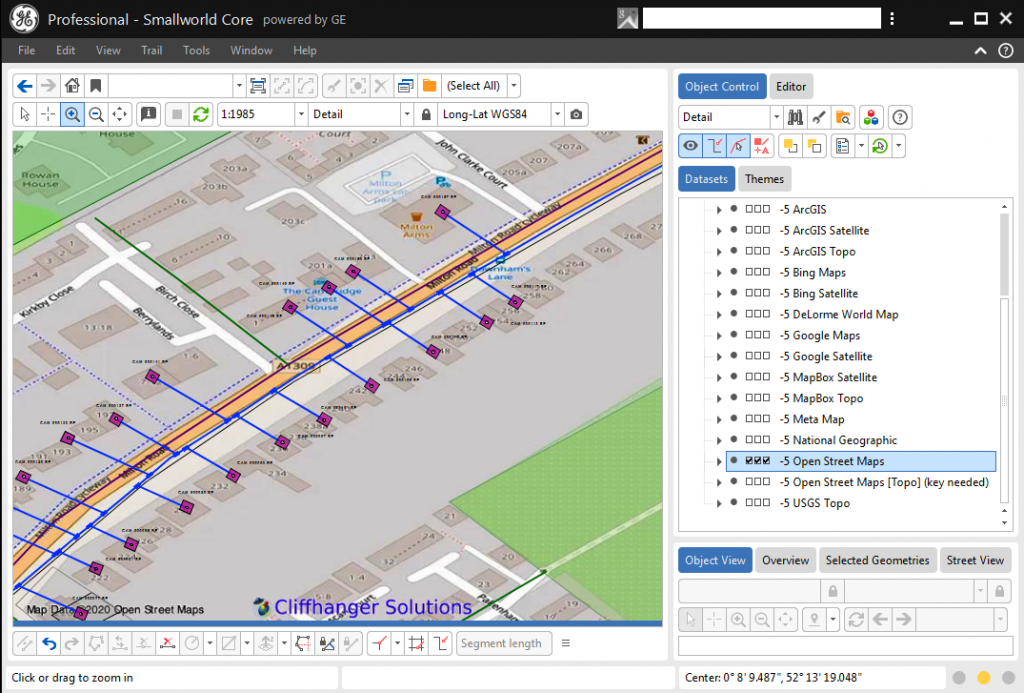
The fifteen-year investment
If your utility has been running Smallworld for a decade or longer, you have something most platforms can't claim: a network model that has survived audits, mergers, regulatory changes, and at least three GIS leadership transitions. Ripping it out is rarely the right answer. The right answer is making it talk.
The integration gap
Where Smallworld struggles isn't in the model. It's in everything around the model. Field crews can't query it on a device. Dispatch can't see live state. ADMS gets a batch export instead of a continuous feed. A new generation of leaders looks at the stack and asks, "why can't we just ask it a question?"
Layer, don't replace
Cliffhanger's approach is to layer above the GIS, not under it. Smallworld stays the system of record for the network model. The platform sits on top, continuously indexing the same data into a sub-100ms operational store, while bidirectional sync (via VMDS and our governed write-back layer) keeps the model authoritative. Nothing gets thrown away.
What that looks like in practice
We typically start with one bounded lane: one district or circuit, one workbench, one team. Field Ops on mobile, reading from Smallworld through the backbone. Discrepancies flow back through Network Governance for office review. Within a few months, the team has a working pattern they can extend. Inside a year, the question "why can't we just ask it?" has a real answer.